 +86-15052135118

 Español
 Get In Touch


A conveyor coupling starts slipping on its motor shaft after six months, and the polished wear patch on the shaft tells the story: the set screws were never matched to the load. Set screws are headless, fully threaded fasteners that hold a hub, pulley, or collar to a shaft by pressing a hardened point into the shaft surface. They transmit radial clamping force instead of axial tension, which is why they appear throughout gearboxes, motor shafts, sprockets, and door hardware.
Every set screw carries a stack of engineering choices: point geometry, material grade, thread class, and tightening torque. A wrong selection produces the same symptoms: lost motion, vibration, creep, and unscheduled downtime. This guide walks through the selection criteria that a plant engineer, maintenance buyer, or fastener distributor should confirm before ordering.
Content
- 1 How Set Screws Create a Secure Fixing
- 2 Set Screw Point Styles: Match the Point to the Job
- 3 Set Screw Materials and Strength Grades
- 4 Set Screw Sizes, Threads, and Tightening Torque
- 5 Set Screw vs Machine Screw: When a Set Screw Is Not Enough
- 6 Why Set Screws Loosen and How to Prevent It
- 7 How to Install a Set Screw Correctly
- 8 Set Screw FAQ
How Set Screws Create a Secure Fixing
A set screw secures a joint by converting input torque into a concentrated clamping force at its point, and that point determines how much of the force is actually transferred to the shaft.
Set screw definition: a headless fastener threaded over its full length, designed to apply radial force through its point against a mating surface to prevent relative rotation or axial sliding between two assembled parts.
The thread converts applied torque into axial force along the screw axis. Because the screw is driven into a tapped hole, its point presses hard against the shaft, and a hardened point makes a small indentation that raises friction and holds the assembly together. Since the screw has no head, the whole unit sits flush inside the hub, which matters in rotating assemblies where imbalance is a real concern.
Set Screw Point Styles: Match the Point to the Job
The point style dictates how a set screw interacts with the shaft, and choosing the wrong point is the most common field failure.
| Point style | Geometry | Best application | Limitation |
| Cup point | Hollow cup with sharp rim | General shaft and hub locking on steel | Can scar hardened shaft surfaces |
| Cone point | 90 degree cone | Centering parts in a drilled mark | Needs a mating center mark |
| Flat point | Flat end face | Frequent adjustment on soft shafts | Lower holding force |
| Dog point | Shouldered tip | Positive axial location in a hole | Requires a matching hole |
| Oval point | Curved tip | Pivots and temporary positioning | Weakest clamping force |
For most industrial shaft-locking jobs the cup point is the default: its hardened rim bites a fraction of a millimeter into steel, and the resulting indentation keeps the screw from backing out. Choose a cone or dog point when the assembly must index to the same location every time, and use flat or oval points only when the surface must stay unmarked.
Rule of thumb: cup for strength, cone for centering, dog for location, flat for frequent adjustment.
Set Screw Materials and Strength Grades
Carbon steel, stainless steel, and heat-treated alloy steel cover the set screw market, and the material grade sets both the maximum tightening torque and the working life.
Metric set screws are classified in 14H, 22H, or 45H hardness classes. A 45H carbon steel set screw, case-hardened to HRC 45, is the workhorse for dry indoor machinery; zinc plating adds moderate corrosion resistance. For washdown lines, marine equipment, or outdoor exposure, an SUS304 stainless steel set screw is the safer call because it survives years of humidity without rusting. Wuxi Sharp Metal Products Co., Ltd., a screw producer operating since 1993 in Wuxi, Jiangsu, lists SUS304 set screws as a standard catalog item alongside its carbon steel line.
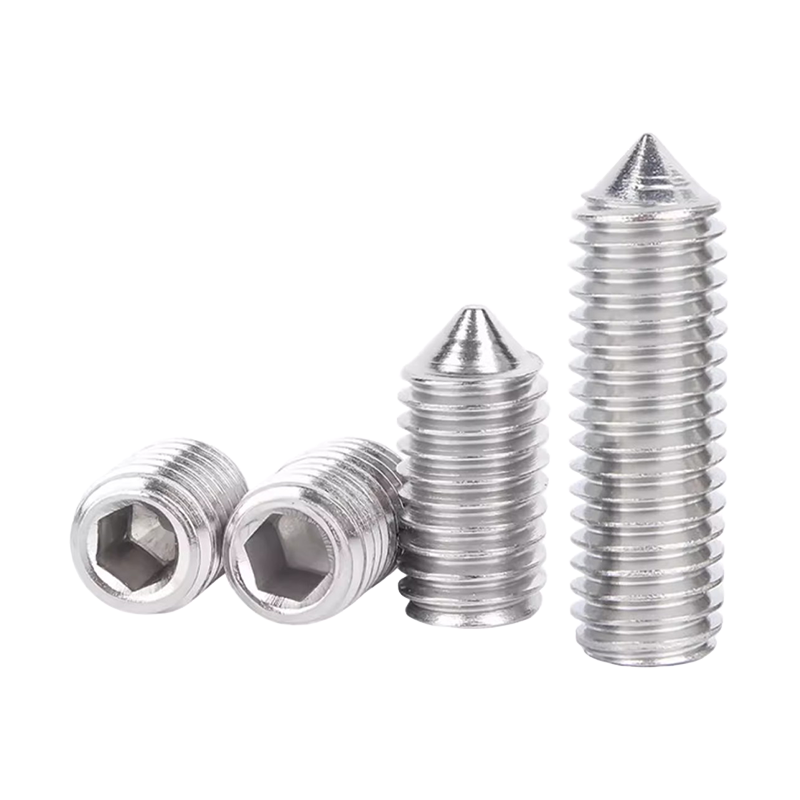 SUS304 Stainless Steel Hex Socket Set Screw with Pointed or Flat EndThis corrosion-resistant set screw suits washdown lines, marine gear, and outdoor equipment where humidity would rust carbon steel, with hardness options like pointed or flat ends for secure positioning.View Product →
When service temperature stays high or the screw must remain harder than the shaft, SUS410 martensitic stainless is heat-treated to higher hardness and resists wear. The data behind that choice is covered in the SUS304 versus SUS410 stainless steel set screw comparison.
Selection rule: 45H carbon steel for clean dry equipment; SUS304 for wet or corrosive environments; SUS410 when hardness and elevated-temperature resistance matter more.
Set Screw Sizes, Threads, and Tightening Torque
Size selection starts with the hub hole, then follows the standard metric series from M3 to M20; the tightening torque is what actually determines reliability.
Metric set screws use coarse threads as standard: M3 x 0.5, M4 x 0.7, M5 x 0.8, M6 x 1.0, M8 x 1.25, and M10 x 1.5. Screw length is measured over the full thread, so pick a length that lets the point travel through the hub wall and bear on the shaft without bottoming out in the tapped hole.
| Diameter | Hex socket | Max torque |
| M3 | 2.0 mm | 0.6 Nm |
| M4 | 2.5 mm | 1.4 Nm |
| M5 | 3.0 mm | 2.8 Nm |
| M6 | 4.0 mm | 4.9 Nm |
| M8 | 5.0 mm | 12 Nm |
| M10 | 6.0 mm | 24 Nm |
Use the maximum values with a torque wrench. If the threads are lubricated, reduce the value to about 60 percent; friction drops, and the same wrench setting will overstress the thread.
Practical note: a worn hex key, converted from imperial to metric, rounds out the socket before the set screw reaches torque. Check the key fit first.
Set Screw vs Machine Screw: When a Set Screw Is Not Enough
A set screw supplies radial locking force, not axial tension, so any joint that must carry tension or shear belongs to a headed machine screw or bolt.
Set screw
Headless, flush-mounted, point anchors into the shaft. Handles positioning and anti-rotation of hubs, collars, and pulleys. Not designed to pull parts together.
Machine screw
Headed, clamps mating faces together, carries tension and shear load, easily removed for inspection. Used where preload across the joint is required.
Many gearbox assemblies use both: set screws locate the gear hub radially, and machine screws hold the cover or the coupling flange. The design question is which mode fails first, and that answer picks the fastener.
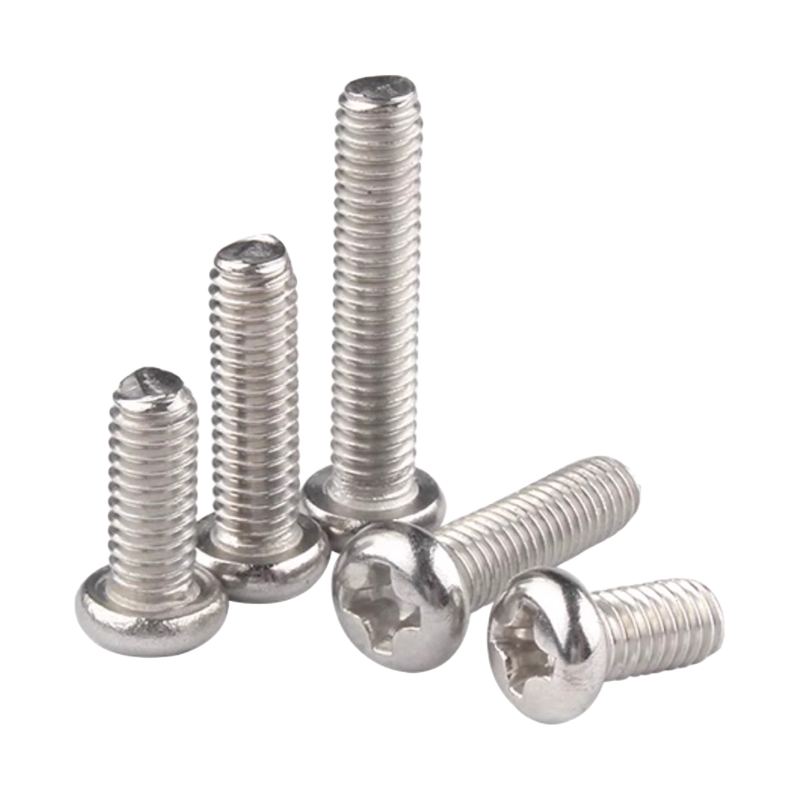 SUS304 Stainless Steel Machine Screws in Multiple Head StylesThese 304 stainless machine screws offer corrosion resistance and strength for gearbox covers or coupling flanges, available in countersunk, round, and hex heads to match assembly needs.View Product →
Use this test: if the part slides axially while the set screw is snug, the joint needs a machine screw or a bolt, not a longer set screw.
Why Set Screws Loosen and How to Prevent It
Set screw loosening under vibration is a torque and point geometry problem, not a fastener quality problem, and the prevention sequence is well documented.
- Low assembly torque, so the point never bites into the shaft
- Wrong point style for the shaft hardness
- Oversized tapped hole, worn threads, or reused screws with deformed points
- Vibration and thermal cycling that relax preload over time
- Missing thread-locking compound on the screw thread
Prevention follows the same sequence in reverse: retorque after the first 24 hours of run-in, apply a thread-locking adhesive, drill a shallow center mark for cone points, and, where the set screw passes through the hub, run a standard hex nut onto the protruding threads as a jam nut. DIN934 hex nuts are the standard pick here.
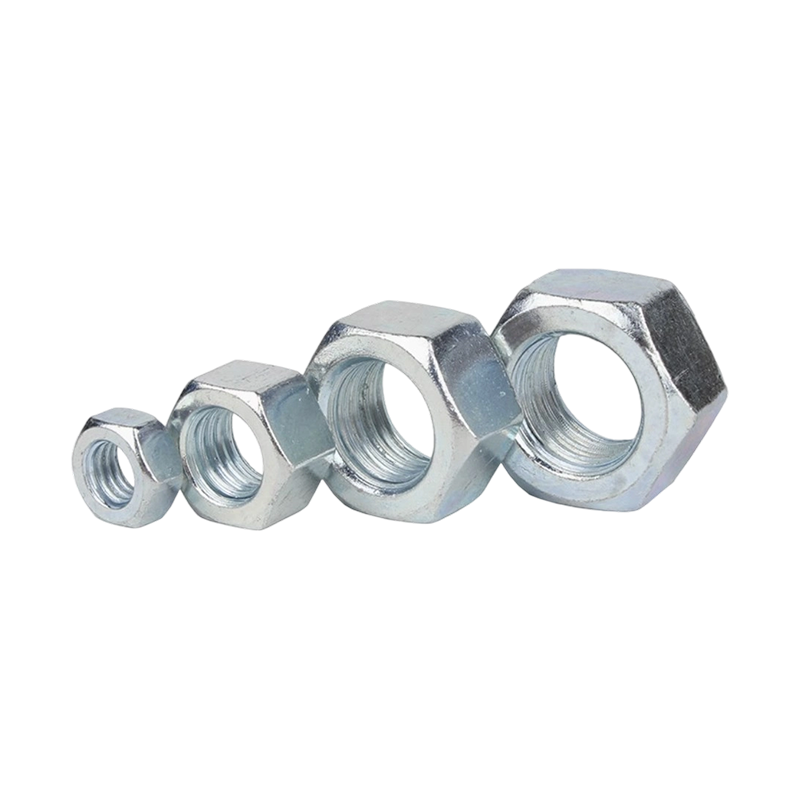 DIN934/GB6170 Hexagon Nut for Jam Nut and Fastening ApplicationsThis standard hex nut pairs with set screws or bolts to secure components, useful as a jam nut on protruding threads to prevent loosening in mechanical and structural assemblies.View Product →
A set screw that backs out is a maintenance signal: log the torque used, mark the screw position, and inspect it on the first scheduled stop.
How to Install a Set Screw Correctly
Correct installation is a six-step sequence that begins with cleaning the shaft and ends with a confirmed torque value.
- Clean the hub bore and the shaft contact area with a degreaser and remove burrs from the tapped hole.
- Verify the thread fit; standard set screw and tapped hole classes are 6g and 6H.
- Apply a light drop of thread-locking compound to the screw threads.
- Start the set screw by hand until the point touches the shaft.
- Tighten with the correct hex socket from the torque table in one smooth pull.
- Mark the screw position on the shaft and recheck torque after the first hours of service.
Set screw reliability is decided before the order goes out. Wuxi Sharp Metal Products Co., Ltd. has produced and exported screws since 1993 from a 6,000-square-meter plant, with more than 800 tons of stock and an annual output around 2,000 tons. Review the full set screw selection at the factory site and request a torque-tested sample batch before committing to a large order.
Set Screw FAQ
Quick reference: ISO 4026 flat point, ISO 4027 cone point, ISO 4028 dog point, ISO 4029 cup point.
What is the difference between a set screw and a grub screw?
None in practice. Set screw is the standard term in ISO and DIN standards and in North America, while grub screw is the common British-English name for the same headless threaded component.
Which set screw point is best for a hardened shaft?
Use a cone point with a center-drilled mark. The cone wedges into the hole and does not depend on the shaft surface to accept an indentation; a cup point will at best polish a hardened shaft and can skid.
What torque should I use for an M6 set screw?
For a hardened 45H carbon steel cup-point M6 set screw on dry threads, use about 4.9 Nm maximum. If you add thread-locking compound or lubrication, reduce the setting to roughly 60 percent of that value.
Can I reuse a set screw that has already been tightened?
Reuse is acceptable when the point and the hex socket are undamaged and the thread is still true. Discard screws with a rounded cup rim, a worn socket, or stretched threads, because in rotating equipment the part cost is always lower than the downtime.