 +86-15052135118

 Español
 Get In Touch


On most assembly benches and job-site trucks the washer bins sit side by side: DIN 125 flat washers in one, DIN 127 spring lock washers in the other. To a new buyer they look interchangeable. They are not. The lock washer vs flat washer decision decides how a bolted joint behaves for its entire service life: one washer manages pressure, the other fights rotation, and picking the wrong one rarely shows up at inspection time. It shows up two years later, when a vibrating conveyor bracket starts working loose.
This guide compares the two types on function, geometry, governing standards and real vibration behavior, then walks through a stacking order you can hand straight to the shop floor. All size examples use common metric hardware: M8, M10 and M12 bolts in property class 8.8.
Content
- 1 What a Flat Washer Does: Spreading Load, Protecting Surfaces
- 2 What a Lock Washer Does: The Spring That Fights Back-Out
- 3 Lock Washer vs Flat Washer: Side-by-Side Comparison
- 4 What Vibration Testing Shows About Spring Washers
- 5 Lock Washer vs Flat Washer in Practice: Stacking Order on the Bolt
- 6 Material and Coating: Matching Washers to the Working Environment
- 7 Frequently Asked Questions
What a Flat Washer Does: Spreading Load, Protecting Surfaces
A flat washer is a thin, flat ring, flat on both faces, that spreads the clamping force of a bolt or nut over a wider bearing area and shields the joint surface from scoring and embedment.
A flat washer is an annular plate of uniform thickness placed under a bolt head or nut to distribute load, protect surfaces and bridge oversize holes. Its dimensions are governed by DIN 125 from the German standards body (Deutsches Institut fuer Normung), also supplied to GB 97.1 in the Chinese standard system, with hardened grades under ISO 7089 and 7090.
The numbers are simple. A DIN 125A washer for an M8 bolt measures 8.4 mm inside diameter, 16 mm outside diameter and 1.6 mm thick. Its job is arithmetic: the same clamp load spread over a larger area means lower surface pressure, so softer base materials such as aluminum, timber, sheet metal and plastic do not bruise or pull through under the nut.
How much area does the washer actually add? Using standard nut face (dw) dimensions against DIN 125 washer dimensions, the effective bearing area more than doubles at M8 and M10, and nearly triples at M12:
Where a flat washer earns its place:
- Soft or thin base materials: aluminum extrusions, timber, gypsum and plastic assemblies
- Oversize, slotted or elongated holes where a bare nut could pull through
- Painted, anodized or galvanized faces that must not gall during tightening
- Any assembly where consistent torque-tension behavior matters
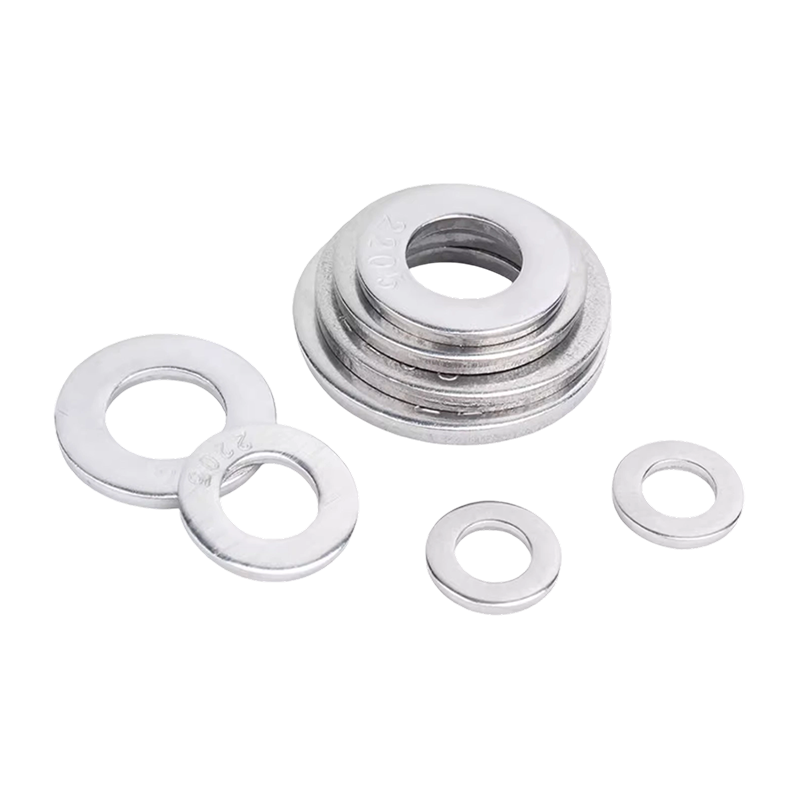 DIN125 / GB97.1 Flat WashersThese German-standard flat washers spread bolt and nut loads, protect mating surfaces from wear, and improve joint stability, making them the baseline choice wherever a flat washer earns its place.View Product →
What a Lock Washer Does: The Spring That Fights Back-Out
A lock washer is a split, helically coiled ring of hardened spring steel that pushes back against a nut or bolt head to resist unintentional rotation.
A helical spring lock washer (DIN 127) is a single-turn coil spring with squared, offset ends. Compressed under the nut, it stores spring energy, and its hardened ends dig into the bearing surfaces to add friction against rotation.
For an M8 bolt the DIN 127 ring is about 2.0 mm thick. The design idea is a live spring force under the nut. In practice the story is more modest: once the nut reaches full torque, the coil is already flattened nearly level. Experienced fitters know that by final torque it behaves close to a flat ring, so most of the locking action comes from the bite of its ends rather than from remaining spring travel.
That bite is useful on rigid joints, steel on steel, where the parts cannot slide much: machine frames, fixed brackets, housings. On soft surfaces the ends chew into the base material, raise burrs, and can make loosening easier rather than harder.
Practical places a spring lock washer still makes sense:
- Rigid steel-to-steel joints exposed to light, intermittent vibration
- Non-critical retrofits where a prevailing-torque nut is not on hand
- Through-bolted connections where the nut is the rotating member
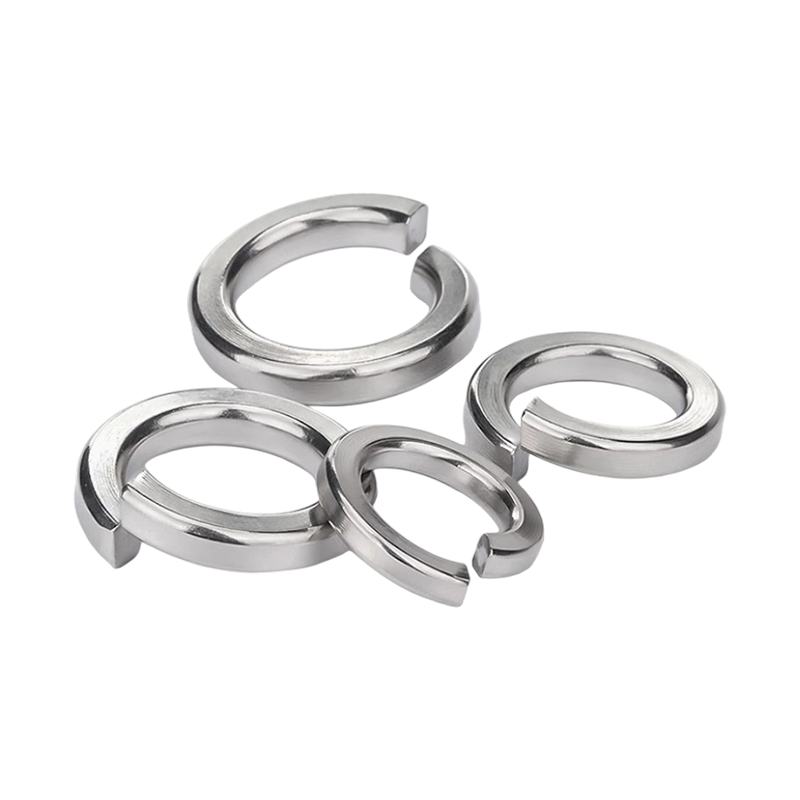 DIN127 Spring Lock WashersAvailable in internal and external expansion types, these hardened spring washers push back against nuts and bolts to resist loosening from vibration, ideal in the practical places described here.View Product →
Lock Washer vs Flat Washer: Side-by-Side Comparison
The core difference is easy to state: a flat washer controls pressure and surface damage, a lock washer resists loosening, and neither one can do the other's job.
| Attribute | Flat washer (DIN 125 / GB 97.1) | Spring lock washer (DIN 127) |
| Primary job | Spread load, protect surface | Resist rotation through bite and spring force |
| Geometry | Flat annulus, uniform thickness | Split helical coil, offset squared ends |
| Typical material | Carbon or stainless steel, hardened for class 8.8 and above | Hardened spring steel |
| On soft base material | Ideal, lowers surface pressure | Poor, ends bite and mar the face |
| Under vibration | Neutral, adds no locking | Mixed, preload can decay under transverse motion |
| Reusability | Good if not visibly deformed | Limited, flattened or cracked rings get scrapped |
| Standard position | Under bolt head and under nut | Directly under the nut |
Choose a flat washer when
- The base material is soft: aluminum, wood, plastic, gypsum
- The hole is oversize or the surface is finished
- You need stable torque-tension behavior
Reach for a lock washer when
- The joint is rigid steel-on-steel with intermittent vibration
- A nut could back off during service
- You want a low-cost retrofit on a non-critical assembly
One more contrast for buyers: flat washers are commodity items bought by the ton. Spring lock washers are hardened components whose function dies with the first over-torque, so treat their quality checks differently.
What Vibration Testing Shows About Spring Washers
Laboratory transverse vibration testing has repeatedly shown that a split lock washer can lose most of its preload, which is why engineers treat it as a light-duty locking aid, not a critical-joint solution.
The DIN 65151 test, known as the Junker test, clamps a joint and then shakes it transversely at controlled amplitude while a sensor logs the residual clamp force. In widely reproduced curves, assemblies with helical spring washers show a steep early drop in preload, often falling to a small fraction of the initial value within the first phase of the run. The same joint, correctly torqued without the split ring, holds its clamp force far longer.
Two things drive that result. The coil is already flat at assembly torque, so it has almost no travel left to absorb motion. And under transverse sliding, the rotating parts overcome the small end-bite friction, leaving a slotted, stress-raising shim in the joint.
Purchasing takeaway: keep lock washers for static, rigid joints, and spend the real budget for vibration duty on prevailing-torque nuts, flanged fasteners with sensible clamp length, and torque-controlled assembly.
Lock Washer vs Flat Washer in Practice: Stacking Order on the Bolt
A workable shop-floor default: flat washer under the bolt head, spring lock washer under the nut, and a second flat washer between the lock washer and any soft or finished surface.
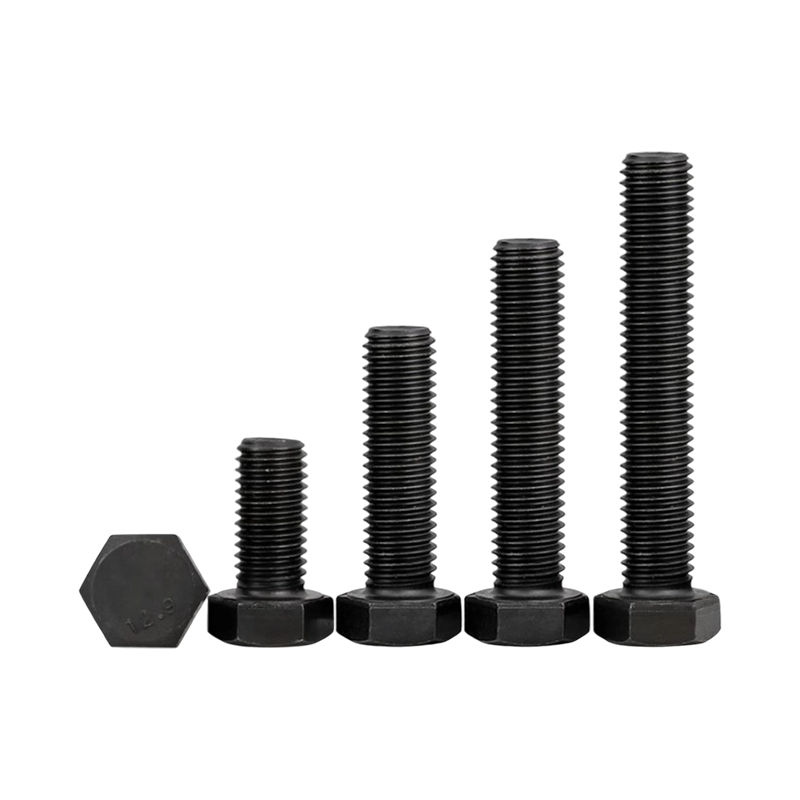 DIN933 / DIN931 Hexagon BoltsFull-thread DIN933 and half-thread DIN931 hex bolts pair well with the flat-plus-lock washer stacking arrangement, handling higher torque, load, and longer connections on the shop floor.View Product →
Do not pair a spring lock washer with a flanged bolt head or flanged nut. The flange already spreads the load, the ring just tilts on it, and you get neither function properly.
Material and Coating: Matching Washers to the Working Environment
Washer material must match both the bolt and the environment: stainless steel outdoors and in wet zones, coated carbon steel indoors, hardened steel under high-strength bolts.
- Stainless steel, typically 304, for outdoor, coastal, humid or wash-down locations, and keep the whole set stainless so crevice corrosion has no easy partner
- Coated carbon steel, zinc-plated or similar, for dry indoor assemblies, matched to the bolt's own coating so one part does not corrode first
- Through-hardened steel washers under property class 8.8 and 10.9 bolts, because an unhardened washer embeds and loses its bearing area
Coating choice follows the same cost-corrosion trade-offs as screws. The stainless vs galvanized vs zinc-plated comparison lays out the math if you are weighing budget against service environment.
Buying note: washers rarely travel alone. Wuxi Sharp Metal Products Co., Ltd., a screw and fastener manufacturer founded in 1993 in Wuxi, Jiangsu, lists DIN 125 flat washers, DIN 127 spring washers, hex bolts and hex nuts to DIN and GB standards from one inventory, which keeps hardness and coating matched across the set. For a broader checklist on judging a supplier before you commit volume, this guide to fastener manufacturing factories for buyers and engineers is a practical starting point.
Frequently Asked Questions
Can you use a lock washer and a flat washer together?
Yes, and it is common. The flat washer faces the joint surface; the lock washer sits against the nut so its ends can bite. On soft surfaces, put a flat washer between the joint and the spring washer.
Does the lock washer go under the nut or under the bolt head?
Usually under the nut, because the nut is the component that rotates during tightening and service. Under a plain bolt head it works too, but the nut side is the convention most drawings follow.
Can a spring lock washer be reused?
Treat it as single-use. Once flattened, cracked or visibly bitten, it no longer supplies spring force or a clean bite, and reused rings are a recurring cause of loose connections found during maintenance.
Do I always need a lock washer on a bolted joint?
No. Rigid, static joints with correct torque often never loosen. Add locking only where rotation risk exists, and remember that a flat washer remains the right answer whenever the real problem is surface pressure rather than loosening.
Rule of thumb: flat washer where pressure is the problem, lock washer where rotation is the problem, both together where the surface is soft and the nut can still turn.