 +86-15052135118

 Español
 Get In Touch


A wall mount rated for 77 in. screens still arrives as the same puzzle: a bracket, a bag of unlabeled bolts and nothing that says which bolt goes where. The TV mount screw size question is really two questions, because every installation runs on two fastening systems at once. Small machine screws tie the arm to the VESA holes molded into the back of the panel, while heavy structural bolts carry the whole assembly into the wall behind it.
The panel side is standardized by the Video Electronics Standards Association (VESA), so the right choice takes seconds to look up once the hole pattern is measured. The wall side depends on what the wall is built from, and that is where nearly every dropped-television story starts. Mix the two up and the result is a stripped insert, a cracked screen or a plate on the floor.
Two systems, one install: M4 to M8 machine screws behind the panel, and 1/4 to 3/8 in. lag bolts or wedge anchors on the wall side.
Content
- 1 TV Mount Screw Size Chart: M4, M6 and M8 by VESA Pattern
- 2 How to Measure the VESA Pattern and Screw Depth Without Guesswork
- 3 Wall-Side Screws: Lag Bolts for Studs, Wedge Anchors for Concrete
- 4 Fastener Materials: SUS304 Behind the Panel, Coated Carbon Steel on the Wall
- 5 Five Mounting Mistakes That Crack Screens or Drop TVs
- 6 TV Mount Screw Size: Frequently Asked Questions
TV Mount Screw Size Chart: M4, M6 and M8 by VESA Pattern
Most flat-panel televisions use M4, M6 or M8 machine screws, and the correct TV mount screw size is dictated by the VESA hole pattern on the back of the set rather than by the brand on the bezel. The pattern is printed in the manual as a MIS class and often appears on a label near the ports.
A VESA pattern is the standardized grid of threaded mounting holes defined by the Video Electronics Standards Association, written as horizontal x vertical spacing in millimeters, such as 100x100 or 400x400. Almost every flat-panel TV sold worldwide follows this interface.
Samsung's published support guidance is a useful sanity check: 19 to 22 in. sets take M4, 30 to 40 in. sets take M6, and 43 to 88 in. sets take M8. Thread pitch matters as much as diameter, because M4 runs at 0.7 mm, M6 at 1.0 mm and M8 at 1.25 mm, so a screw from the wrong class simply refuses to seat. Length is the third variable: too long and the screw bottoms out against internal ribs or cables; too short and only a few threads grip the brass insert before it strips.
| VESA pattern | Typical screen size | Screw size | Thread pitch | Common length |
| 75x75 | Up to 32 in. | M4 | 0.7 mm | 8 to 12 mm |
| 100x100 | 23 to 43 in. | M4 | 0.7 mm | 10 to 12 mm |
| 200x100 or 200x200 | 32 to 55 in. | M6 | 1.0 mm | 12 to 16 mm |
| 400x200 or 400x400 | 43 to 75 in. | M8 | 1.25 mm | 14 to 20 mm |
| 600x400 | 60 to 88 in. | M8 | 1.25 mm | 16 to 25 mm |
Treat the chart as a starting point, because recessed inserts and supplied spacers can change the effective length by several millimeters. Before ordering replacements, cross-check diameters and pilot hole sizes against a full screw size chart as well.
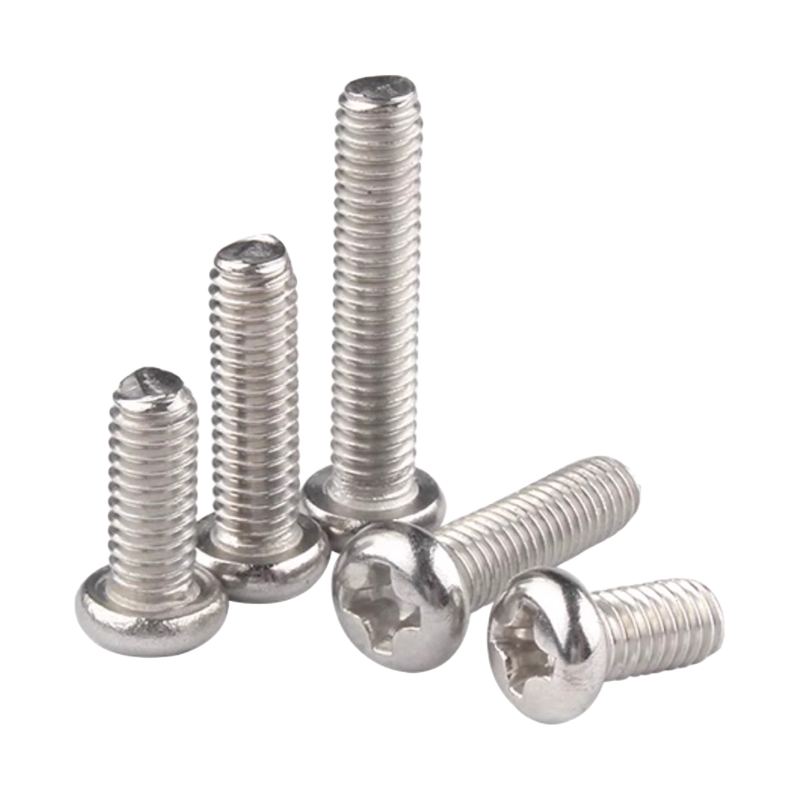 SUS304 Stainless Steel Machine ScrewsStainless 304 machine screws offer corrosion resistance and stable clamping for panel hardware. When recessed inserts and spacers change effective length, verifying screw diameters and lengths before ordering these replacements avoids costly rework.View Product →
How to Measure the VESA Pattern and Screw Depth Without Guesswork
Two minutes with a metric ruler and a toothpick settles the screw question before any drilling starts.
- Measure the pattern. Measure center to center between the holes, horizontally and vertically, and write the result as width x height. Four holes in a rectangle means measuring the outer pairs; 100x100 is the most common small-set result.
- Identify the thread. Try an M4, M6 and M8 gently by hand in one hole, or match the MIS class in the manual. The right thread starts smoothly; forcing a wrong pitch chews the insert.
- Probe the depth. Push a toothpick in until it stops, mark it and measure. Aim for thread engagement of at least 1.5 times the screw diameter: about 6 mm for M4, 9 mm for M6 and 12 mm for M8.
- Check for spacers. Look for recessed inserts, cable channels or a curved back. These call for standoffs or washer stacks so the plate sits flat without bowing the panel.
The engagement rule: a machine screw needs at least 1.5 times its diameter of thread in metal. Shorter than that, the insert strips long before the mount reaches half its rated load.
Wall-Side Screws: Lag Bolts for Studs, Wedge Anchors for Concrete
A mount stamped for 175 lbs still fails on the wrong wall fastener: wood studs take lag bolts, solid masonry takes wedge anchors, and bare drywall takes neither.
Wood stud walls
- 1/4 in. lag bolts are the floor; step up to 5/16 or 3/8 in. for large panels
- Engage at least 2 in. of thread in the stud center, never the edge
- Drill a pilot hole slightly smaller than the shank so the stud does not split
Concrete and brick walls
- Wedge or sleeve anchors sized to the mount slots, typically 1/4 to 3/8 in.
- Drill to the anchor specification and blow the dust out before setting
- Keep anchors 2 in. from slab edges and out of mortar joints
Working load scales with diameter and embedment, which is why mount makers publish minimum lag sizes instead of vague advice. These are typical single-bolt figures for softwood framing:
Typical working load of one lag bolt in a softwood stud, 2 in. thread embedment
Illustrative planning values; wood species, pilot size and embedment change the result. Always defer to the mount rating.
Solid concrete works differently. A wedge anchor grips the drilled hole by expansion as the nut is torqued, so capacity comes from compression rather than wood fibers, and a 65 in. panel bolts to a slab with four anchors and no stud hunting at all.
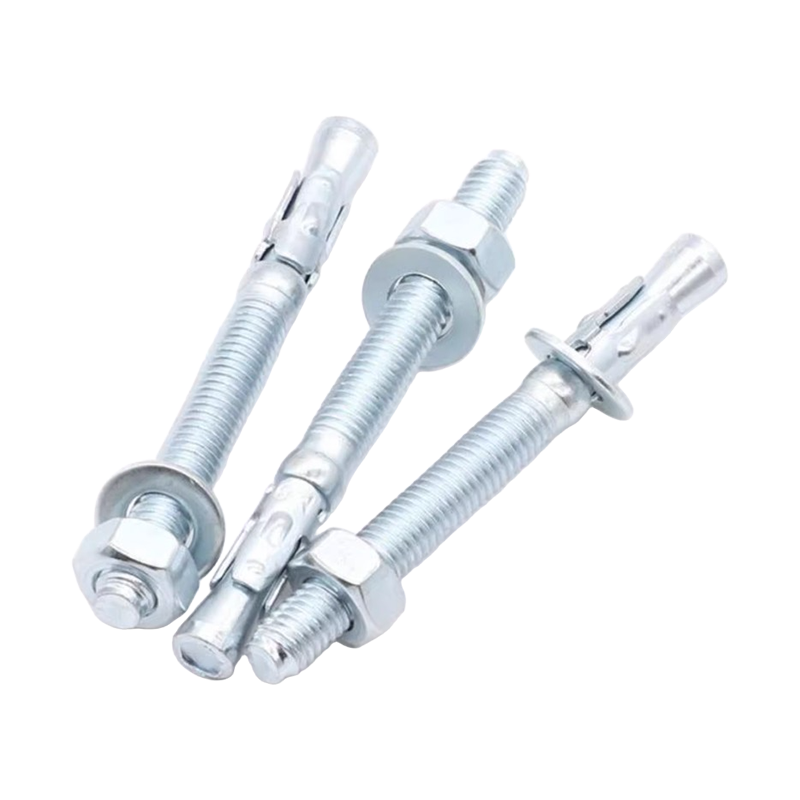 Wedge Anchor Expansion BoltsWedge anchors grip drilled concrete by expanding as the nut is torqued, so capacity comes from compression rather than wood fibers. They suit slab mounting of wall panels where stud hunting is unnecessary.View Product →
Steel studs and commercial frames
Commercial frames often hide thin sheet steel studs that peel their threads under a lag bolt. Use a toggle-style anchor, or span two studs with a plywood or steel backing plate and bolt through it with structural hexagon bolts and washers to spread the clamp load.
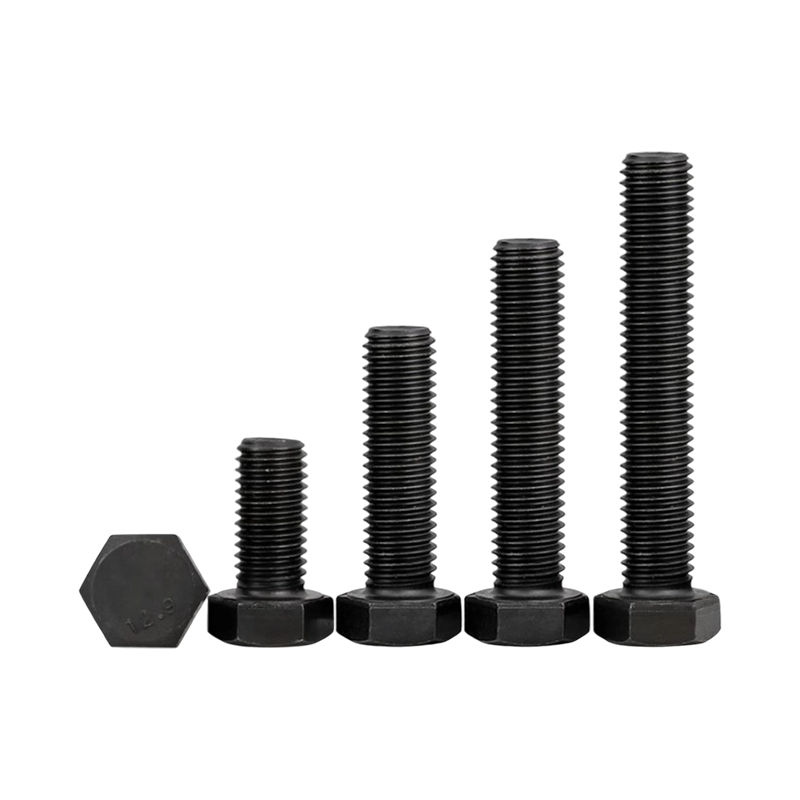 DIN933/DIN931 Hexagon BoltsFull-thread DIN933 and half-thread DIN931 hexagon bolts spread clamp load when paired with washers on backing plates, making them a practical choice for mounting hardware into hollow studs or structural framing.View Product →
Fastener Materials: SUS304 Behind the Panel, Coated Carbon Steel on the Wall
Material should follow the job: precision stainless steel behind the panel where threads are delicate, and high-strength coated carbon steel on the wall side where clamping force rules.
- SUS304 machine screws: smooth, corrosion-free threads that protect the brass inserts behind the panel from galling and rust stains.
- SUS410 screws: heat-treatable hardness for self-drilling and metal-framing work, which is why they rarely appear behind the panel.
- Coated carbon steel lags and anchors: the highest tensile strength for the wall side, with zinc or phosphate plating for indoor humidity.
Consistency across that range separates a hardware store assortment from an engineered supply. A screw manufacturer such as Wuxi Sharp Metal Products Co., Ltd. runs carbon steel, SUS304 and SUS410 lines side by side, keeping thread pitch, head tolerance and coating thickness uniform when a project needs hundreds of matched fasteners rather than four.
Quality is in the details. For fasteners holding a $900 screen above a sofa, the details are thread pitch, engagement depth and embedment, and none of them forgive guesswork.
Five Mounting Mistakes That Crack Screens or Drop TVs
Nearly every failed television installation traces back to one of five avoidable errors.
- Substituting drywall or wood screws for lag bolts. They may fit the slot, but drywall screws are hardened and brittle, and they snap under the shear load of a swinging panel.
- Running panel screws too long. A screw that bottoms out presses against internal ribs or cables, and the pressure can crack the screen from behind days later.
- Trusting drywall alone. Paper-faced plaster carries almost no sustained load, and even rated toggles suit smaller sets better than a 55 in. panel.
- Overtightening M4 screws. Brass inserts strip at low torque, so snug the screw and add a small quarter turn, not a wrist workout.
- Skipping spacers on curved backs. Pulling the plate tight against a curved cabinet bows the panel and distorts the image.
A 65 in. panel commonly weighs 55 lbs or more, and the wall side carries that weight plus every bump and pull on the screen. No screw size can rescue an install that never reached a stud or a slab.
TV Mount Screw Size: Frequently Asked Questions
What screw size does my TV need?
Read the VESA pattern first: patterns at or below 100x100 take M4, 200x200 class sets take M6, and 400x400 and larger take M8. As a cross-check, Samsung lists M4 up to 22 in., M6 from 30 to 40 in. and M8 from 43 to 88 in.
Are TV mount screws universal?
The thread and spacing are, because VESA standards are shared across the industry. Length is not: cabinet recesses vary by model, so two 55 in. sets can need different lengths of the same M6 screw. Measure the insert depth before ordering.
Can I mount a TV on drywall without studs?
Only smaller panels, and only on toggle-style anchors rated well above the TV weight. Drywall itself has almost no holding strength. For anything 43 in. or heavier, use lag bolts in two studs or wedge anchors in solid masonry.
What happens if the screws are too long?
They bottom out inside the cabinet. The plate will not pull flat, the threads stop tightening early, and hidden pressure on internal ribs or cables can crack the panel. Pick a length that leaves about 1.5 times the screw diameter engaged.
One-line takeaway: the VESA pattern fixes the thread, the insert depth fixes the length, and the wall material fixes the fastener.