 +86-15052135118

 Español
 Get In Touch


Torque an M10 bolt to spec, run the machine for six weeks, and the nut that felt perfect on the bench can arrive at a fraction of its original clamp load. That gap between first torque and field reality is where the split washer lives: a thin ring of hardened spring steel, cut through at one point, sold by the thousand, and argued over like almost no other fastener in the bin.
Wuxi Sharp Metal Products Co., Ltd. has supplied spring washers, flat washers and the bolts they ride with under matching DIN and GB codes since 1993, so this guide works from both sides of that argument: what a split washer actually does, what vibration testing says about its limits, and how to install, size and source one so it earns its place in the joint.
Content
- 1 What a Split Washer Is and How Its Spring Action Works
- 2 The Vibration Question: What Junker Testing Really Shows
- 3 Split Washer vs Flat Washer: Which Ring Goes Under the Bolt
- 4 How to Install a Split Washer So It Actually Grips
- 5 Spring Steel or Stainless: Choosing the Right Washer Material
- 6 When to Use One and When to Step Up
- 7 Frequently Asked Questions
What a Split Washer Is and How Its Spring Action Works
A split washer works by turning the space under the nut into a compressed spring. Cut a ring of spring steel, pry the two cut ends slightly out of plane, and you have a one-turn coil: when the fastener is torqued down, the ring flattens and pushes back with continuous axial force.
A split washer, also called a spring lock washer or helical spring lock washer, is a one-turn split ring that flattens under clamp load and exerts a spring force between the nut or bolt head and the joint surface, adding friction that resists rotation.
Two things happen at once. The offset ends push back against the nut, and the sharp corners at the split bite into the bearing surface and the nut face, raising the friction that holds the thread still. Standards capture that geometry: DIN 127 form B, with raised offset ends, is the common European version, ASME B18.21.1 covers the helical spring type in North America, and GB 93 is the Chinese code buyers see on packing lists.
For standard metric assemblies, DIN 127 spring washers ship alongside the hex bolts and flat washers they are torqued with, which is exactly how a working fastener warehouse keeps them together.
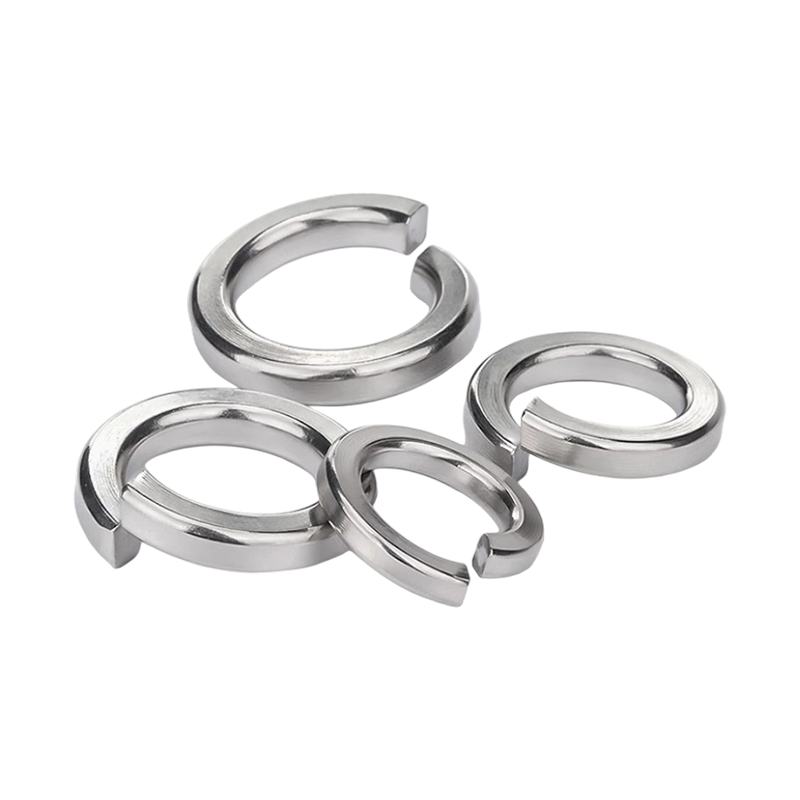 DIN 127 Spring Lock Washers for Metric Bolted AssembliesDIN 127 split spring washers come in internal and external expansion types and are commonly supplied alongside metric hex bolts and flat washers, though VDI 2230 notes they cannot reliably prevent preload loss under transverse vibration.View Product →
The Vibration Question: What Junker Testing Really Shows
Under transverse vibration, a split washer does not reliably stop a bolted joint from losing preload, and European engineering guideline VDI 2230 treats it accordingly.
The evidence goes back to Gerhard Junker's tests in the late 1960s, later standardized as DIN 65151. A Junker test shakes the clamped parts sideways while clamp load is recorded, and sideways slip unwinds a thread faster than any washer can react. Helical spring washers score close to a plain assembly in that motion, and NASA's fastener design manual draws the same conclusion for dynamic joints. That is why demanding specifications move to positive locking instead.
None of this makes the part useless. A split washer adds compliance to short, stiff joints, keeps some tension on the thread if a nut starts to move, and stops a loose nut from spinning off entirely. It is cheap insurance, not a locking device, and buying it with that expectation is the difference between a satisfied and a disappointed assembler.
Split Washer vs Flat Washer: Which Ring Goes Under the Bolt
Flat washers distribute clamp load; split washers add spring force. They solve different problems, and most finished assemblies stack both.
On soft or coated faces, build the stack flat washer down and split washer up, so the load spreads while the spring still works.
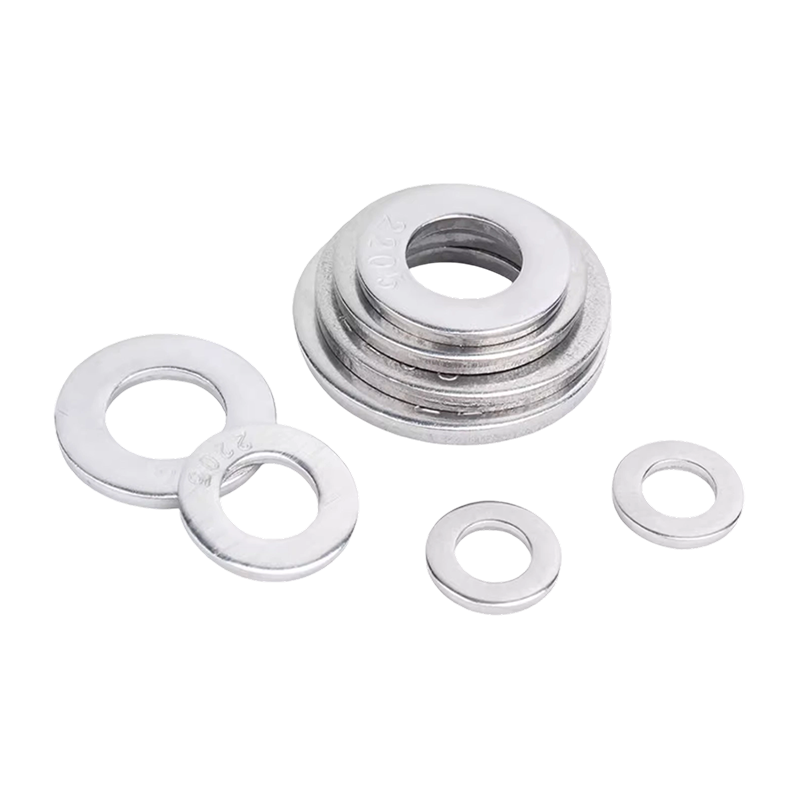 DIN 125 Flat Washers for Load Distribution and Surface ProtectionDIN 125 flat washers spread bolt loads, protect soft or coated surfaces from wear, and improve joint stability. In a washer stack they sit under the split washer so load spreads while the spring action still works.View Product →
Rule of thumb: the split washer always sits under the rotating part, on the nut side, and never directly against a surface you cannot afford to mark.
| Locking method | How it resists rotation | Best fit | Watch-outs |
| Split washer DIN 127 | Spring force plus corner bite at the split | Low-vibration housings, brackets and covers | Loses effect under transverse slip; single use |
| Nylon insert nut | Nylon collar grips the bolt thread | Equipment exposed to shock and handling | Standard nylon softens near 120 degrees Celsius |
| Wedge-locking washer pair | Ramped faces wedge tighter under slip | Safety-critical and high-vibration joints | Needs matched pairing and surface hardness |
| Thread-locking adhesive | Chemical bond across the threads | Small fasteners and sealed assemblies | Slows disassembly; allow full cure time |
How to Install a Split Washer So It Actually Grips
Installation decides most of the outcome, because a split washer that spins on a dirty face is just decoration.
- Clean both bearing faces. Paint flakes, zinc burrs and oil let the whole stack rotate; wipe and deburr before assembly.
- Stack in the right order. Flat washer down against soft or coated faces, split washer on top of it, nut last.
- Seat the split correctly. Cut ends against the joint side and the nut on the smooth convex face, so tightening drives the corners into the material; where a supplier drawing says otherwise, follow the drawing.
- Torque to specification. Under-torque wastes the spring force, and over-torque flattens the ring into a plain washer permanently.
- Re-check after the first run. Thermal cycles and embedment settle the joint, so re-torque where the engineering drawing allows it.
Treat every split washer as single use. A flattened ring keeps no meaningful spring force, and a replacement costs cents while a reworked joint costs hours.
Spring Steel or Stainless: Choosing the Right Washer Material
Match the washer to the bolt, because a mixed pairing usually fails at the softer part.
Standard split washers are made from quenched and tempered spring steel, typically hardened to around 40 to 50 HRC, then phosphated or zinc plated for indoor and general outdoor work. Stainless versions exist for wet and coastal service, but austenitic grades such as A2 (304) cannot reach the same hardness, so their spring force is lower, and pairing stainless washers with stainless bolts also avoids galvanic corrosion.
Coating choice matters as much as grade, and the trade-offs between zinc, phosphate and other finishes are the same ones set out in our guide to carbon steel screw grades and coatings.
For volume buyers, the practical check is batch consistency: hardness and coating thickness should match across the order, which is why standing stock from a single factory with in-house testing beats mixed trading inventory.
When to Use One and When to Step Up
Specify a split washer for static, low and medium duty joints, and step up to positive locking when vibration or safety is real.
- Good fit: control cabinets, sheet-metal enclosures, HVAC flanges, irrigation hardware and furniture joints, torqued once and checked occasionally.
- Marginal: pump and motor brackets, vehicle accessories and conveyor mounts, acceptable with correct preload and scheduled re-torque checks.
- Step up: safety-critical and high-vibration joints, where wedge-locking washer pairs, prevailing-torque nuts or thread-locking adhesive plus correct preload belong.
Whatever locking method you choose, it starts with a correctly graded bolt; DIN 933 and GB 5783 hex bolts thread directly into the washer stacks described in this guide.
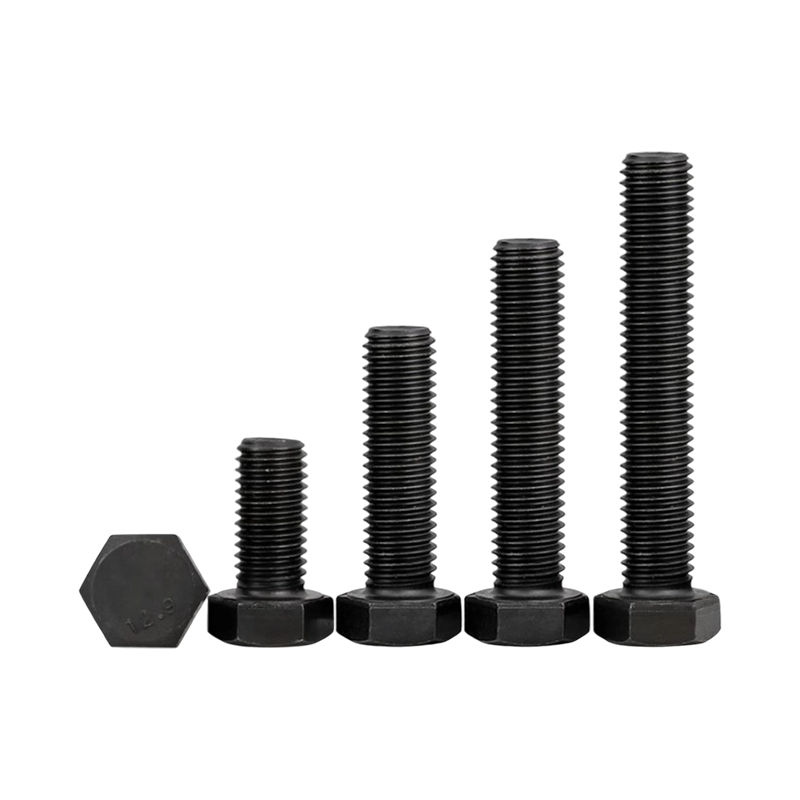 DIN 933 / DIN 931 Hexagon Head Bolts, Full and Partial ThreadDIN 933 full-thread bolts suit longer connections and higher torque, while DIN 931 partial-thread bolts offer a smooth shank for tensile loads. Correctly graded hex bolts form the starting point of any washer locking arrangement.View Product →
Frequently Asked Questions
Which way should a split washer face?
Seat the split ends against the joint surface and let the nut ride on the smooth convex side, so tightening presses the corners into the material. Keep the orientation consistent across an assembly, and replace any ring that has already flattened.
Can you reuse a split washer?
No. The ring takes a permanent set the first time it is torqued, which removes the spring force it exists to provide. Fit a new washer at every disassembly.
Do split washers actually stop loosening?
They add friction and a little spring compliance, which helps in static joints, but Junker-style testing shows little protection against transverse slip. For dynamic or safety-critical joints, use positive locking and correct preload instead of relying on the washer alone.
What size split washer fits an M8 bolt?
A DIN 127 washer with an inside diameter of about 8.4 millimeters suits an M8 bolt. Across sizes the logic holds: inside diameter just above the thread size, with outside diameter and thickness taken from the standard's dimension table.
Source split washers by standard code, hardness and coating rather than by price alone, and every joint downstream of that purchase runs tighter.