 +86-15052135118

 Español
 Get In Touch


Content
What Size Screws for 1/2 Inch Drywall?
For 1/2 inch drywall fastened to wood studs, the correct screw is a #6 coarse thread drywall screw, 1-1/4 inches long. This is the single most common drywall screw used in residential construction and the default choice for wall panels on wood framing.
The 1-1/4 inch length provides approximately 3/4 inch of thread penetration into the wood framing after passing through the 1/2 inch panel — sufficient to meet IRC fastener requirements and achieve the holding strength needed to support the panel through the building's service life. Going shorter risks inadequate penetration and pull-through over time, particularly as wood framing cycles through seasonal moisture changes. Going longer — to 1-5/8 inch — is acceptable and common when contractors want additional pull-out resistance, but adds no practical benefit on standard single-layer 1/2 inch walls.
What Size Screws for 1/2 Inch Drywall on Ceiling?
Ceiling applications use the same panel thickness but demand better holding strength because the screw is resisting gravity rather than racking loads. 1-5/8 inch coarse thread drywall screws are the preferred length for 1/2 inch ceiling panels on wood joists. The extra length — roughly 1-1/8 inch of thread penetration — provides significantly more pull-out resistance against the combined weight of the drywall panel pulling straight down on the fastener head. Some installers use 1-1/4 inch screws on ceilings with no issue, but 1-5/8 inch is the safer specification for overhead applications where fastener failure is not detectable until the panel sags or falls.
Drywall Screw Size for 5/8 Inch Drywall
5/8 inch drywall — used for fire-rated assemblies, Type X applications, and ceilings requiring sag resistance — requires longer screws to maintain adequate penetration into the framing member behind the thicker panel.
- 5/8 inch drywall on wood framing (walls): 1-5/8 inch coarse thread, providing approximately 1 inch of wood penetration.
- 5/8 inch drywall on wood framing (ceiling): 1-5/8 inch minimum; 2 inch preferred for maximum pull-out resistance on overhead panels.
- 5/8 inch drywall on metal framing: Fine thread screws, 1-5/8 inch to 2 inch, depending on metal stud gauge.
- Double-layer 5/8 inch (fire assemblies): The outer layer requires screws long enough to penetrate the framing by at least 5/8 inch after passing through both panels — typically 2-1/2 to 3 inches total length.
Drywall Screw Lengths: Complete Reference
Drywall screws are available in standard lengths from 1 inch to 3-1/2 inches. Each length is suited to specific panel thickness and substrate combinations. The general rule: the screw should penetrate the framing member by at least 5/8 inch, with 3/4 to 1 inch of penetration preferred for production work.
| Screw Length | Best Application | Notes |
|---|---|---|
| 1 inch | 1/4 inch drywall over existing surface | Very limited penetration; specialty use only |
| 1-1/4 inch | 1/2 inch drywall on wood walls | Standard residential wall screw |
| 1-5/8 inch | 1/2 inch ceiling; 5/8 inch walls; metal framing | Most versatile length; high-volume commercial use |
| 2 inch | 5/8 inch ceiling on wood; double-layer 1/2 inch | Good for heavy overhead assemblies |
| 2-1/2 inch | Double-layer 5/8 inch; laminated assemblies | Fire-rated wall and ceiling systems |
| 3 – 3-1/2 inch | Triple-layer or specialty thick assemblies | Uncommon; acoustic or specialty fire assemblies |
Drywall Screw Diameter: #6 vs #8
Drywall screws are sold primarily in two shank diameters: #6 and #8. The number refers to the screw gauge under the Unified National Thread standard — a higher number means a larger diameter.
- #6 drywall screws have a shank diameter of approximately 0.138 inches (3.5 mm). This is the standard diameter for virtually all residential and light commercial drywall work. #6 screws drive cleanly through drywall without fracturing the core, seat flush with the bugle head countersinking just below the paper face without tearing, and provide adequate holding strength for all standard single-layer panel applications.
- #8 drywall screws have a shank diameter of approximately 0.164 inches (4.2 mm) — about 20% larger than a #6. The larger shank provides greater pull-through resistance and shear strength, making #8 screws the correct choice for heavy assemblies, multi-layer panels, and wood framing members wider than 2x4 nominal where deeper penetration is required. #8 screws require more driving torque, increase the risk of paper face damage if over-driven, and are not standard for production residential work. They are more common in commercial and institutional construction where heavier board weights and thicker assemblies justify the larger fastener.
For the vast majority of drywall projects — residential walls and ceilings in 1/2 and 5/8 inch thicknesses — #6 is the correct and sufficient choice. Reaching for #8 screws on standard residential work adds cost and driving difficulty with no practical performance benefit.
Drywall Screw Head Dimensions
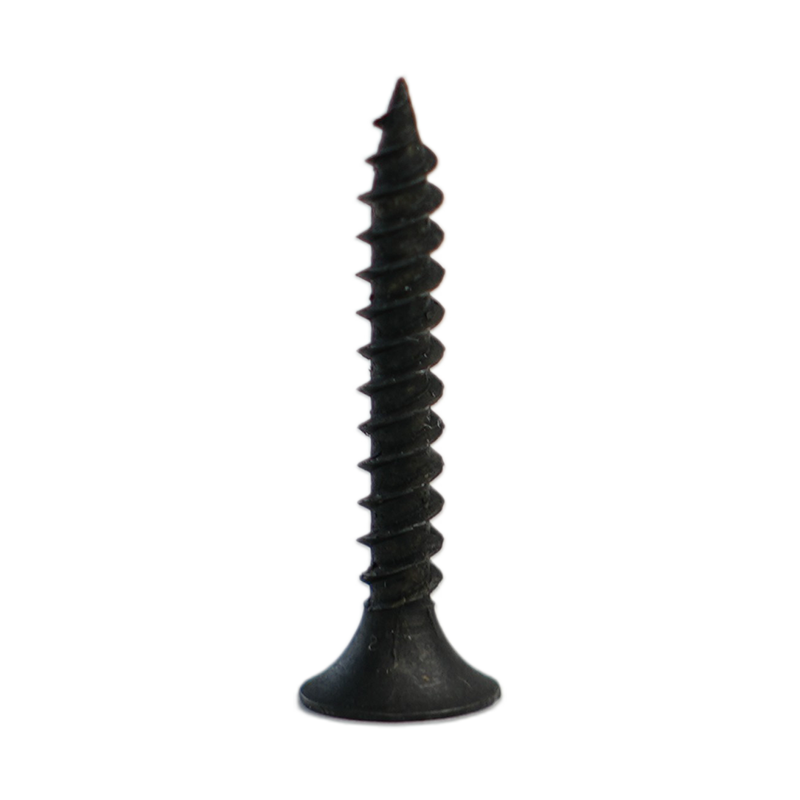
All standard drywall screws use a bugle head profile — a curved concave taper that transitions from the flat head surface to the shank. This geometry is specific to drywall work: as the screw is driven, the bugle head compresses the paper face and gypsum slightly, countersinking itself just below the surface without tearing the paper. A conventional flat-head or pan-head screw with the same shank diameter would tear through the paper face rather than countersinking cleanly, creating a weak fastening point that cannot be properly finished with joint compound.
On a #6 bugle-head drywall screw, the head diameter is approximately 0.323 inches (8.2 mm). On a #8, approximately 0.374 inches (9.5 mm). The recess is a Phillips #2 (most common) or square drive depending on manufacturer — square drive reduces cam-out during production driving but is less universally available.
Coarse Thread vs Fine Thread Drywall Screws
Thread type is the specification that most directly determines whether a drywall screw will perform correctly in a given substrate. Using the wrong thread type is one of the most common drywall fastening errors and one of the easiest to avoid.
Coarse Thread (W-Type)
Coarse thread drywall screws — sometimes called W-type or "wood" screws — have a thread pitch of approximately 9 threads per inch (TPI) on standard sizes. The wide thread spacing drives through wood framing quickly and bites aggressively into the soft wood grain, providing high pull-out resistance with minimal driving effort. Coarse thread is correct for all wood framing: wood studs, wood joists, engineered lumber, and LVL.
Coarse thread screws should not be used in metal framing. The wide thread pitch strips out metal stud flanges rather than threading through them, producing a fastener that spins freely and provides no holding strength.
Fine Thread (S-Type)
Fine thread drywall screws — S-type or "steel" screws — have a tighter thread pitch, typically 18–20 TPI, and a hardened shank with a self-drilling point designed to pierce metal stud flanges. Fine thread is correct for all light-gauge metal framing: 25-gauge through 20-gauge steel studs and tracks. The tight thread pitch engages cleanly with the metal flange, pulling the drywall firmly against the stud without stripping.
Fine thread screws can be used in wood framing in a pinch — they will hold — but they drive harder, require more torque, and tend to deflect in softwood grain rather than driving straight. They are not the efficient choice for wood substrates.
| Thread Type | Thread Pitch | Use With | Do Not Use With |
|---|---|---|---|
| Coarse (W-type) | ~9 TPI | Wood studs, wood joists, LVL | Metal framing (strips out) |
| Fine (S-type) | ~18–20 TPI | Metal studs, steel framing | Not ideal for wood (deflects, drives hard) |
How Many Drywall Screws Per Pound?
Screw count per pound is a practical purchasing and estimating figure. It varies with screw length, diameter, and whether the shank is coarse or fine thread. Longer and heavier screws yield fewer per pound; shorter and lighter screws yield more. The values below are production averages for standard #6 coarse thread bugle-head screws — the most common type used in residential work:
- 1-1/4 inch #6 coarse: approximately 200–220 screws per pound
- 1-5/8 inch #6 coarse: approximately 150–170 screws per pound
- 2 inch #6 coarse: approximately 115–130 screws per pound
- 2-1/2 inch #6 coarse: approximately 85–100 screws per pound
- 1-5/8 inch #6 fine thread: approximately 140–160 screws per pound (slightly heavier shank than coarse equivalent)
For job estimating, the standard fastener rate for single-layer drywall on wood framing is approximately 32 screws per 4×8 sheet for walls (screws at 16 inches on center at the field, 8 inches at edges) and approximately 40–44 screws per sheet on ceilings (tighter spacing). Using these figures with the screw counts per pound above gives a reliable estimate of fastener quantity for bid packages and material orders.
As a rough rule, one pound of 1-5/8 inch drywall screws covers approximately 4–5 sheets of drywall on walls at standard spacing — a useful mental benchmark for small jobs where ordering by the pound rather than the box is practical.