 +86-15052135118

 Español
 Get In Touch


Content
Do Stainless Steel Screws Rust?
The short answer is yes — but with significant qualifications. Stainless steel screws can rust, but the conditions required are far more extreme than those that cause carbon steel or plated fasteners to corrode. Understanding when and why stainless steel rusts is essential for selecting the right fastener grade for any outdoor, marine, or chemically aggressive environment.
Stainless steel resists corrosion through a passive oxide layer — a thin, self-repairing film of chromium oxide that forms spontaneously on the metal surface when exposed to oxygen. This layer, typically just a few nanometers thick, physically blocks moisture and oxygen from reaching the steel beneath. As long as the passive layer remains intact and can reform when damaged, stainless steel does not rust in the conventional sense. The key word is "can reform."
When Stainless Steel Screws Do Rust
Chloride exposure is the primary enemy of stainless steel's passive layer. Chloride ions — present in seawater, salt spray, road de-icing salts, and even some treated timber preservatives — penetrate and break down the chromium oxide film faster than it can repair itself. This process, called pitting corrosion, creates small, deep craters that are far more structurally damaging than the surface rust seen on carbon steel. Marine environments are particularly aggressive: 304 stainless steel screws used within a few hundred meters of saltwater will typically show pitting and rust staining within one to three years, even with no mechanical damage.
Tea staining — a surface discoloration that looks like rust but does not represent structural corrosion — is a common issue with 304 grade fasteners in coastal areas. It is caused by iron-containing particles from fabrication or the atmosphere depositing on the screw surface and rusting independently. Tea staining is largely cosmetic but signals that the environment is aggressive enough to warrant upgrading to 316 grade.
Crevice corrosion occurs in the confined space between a screw head and a substrate, under a washer, or within a threaded engagement. In these areas, oxygen is depleted and cannot replenish the passive layer, allowing corrosion to proceed in conditions where the exposed screw surface shows no signs of rust. Crevice corrosion is a particular failure risk in timber decking applications where screws are countersunk flush and moisture is retained beneath the screw head.
Galvanic corrosion occurs when stainless steel fasteners contact dissimilar metals — particularly aluminium — in the presence of an electrolyte (moisture). The stainless steel acts as the cathode and the aluminium as the anode, accelerating corrosion of the aluminium around the screw. This is a critical consideration for fastening aluminium cladding, boat fittings, and solar panel frames.
Grade Matters: 304 vs. 316 Stainless Steel
304 stainless steel (18% chromium, 8% nickel) is the most widely used stainless grade and handles the vast majority of indoor, sheltered outdoor, and mild atmospheric applications without corrosion. It is not suitable for direct marine exposure or contact with chloride-rich treated timber.
316 stainless steel adds 2–3% molybdenum to the alloy, which substantially increases resistance to chloride-induced pitting. It is the correct choice for marine hardware, coastal construction, swimming pool environments, and contact with ACQ or copper azole treated lumber — preservatives that are highly corrosive to standard stainless grades. Expect a 20–40% price premium over 304 for equivalent screw specifications.
A practical rule: if the application involves salt air, pressure-treated wood, or immersion, specify 316. For everything else, 304 provides more than adequate corrosion resistance at lower cost.
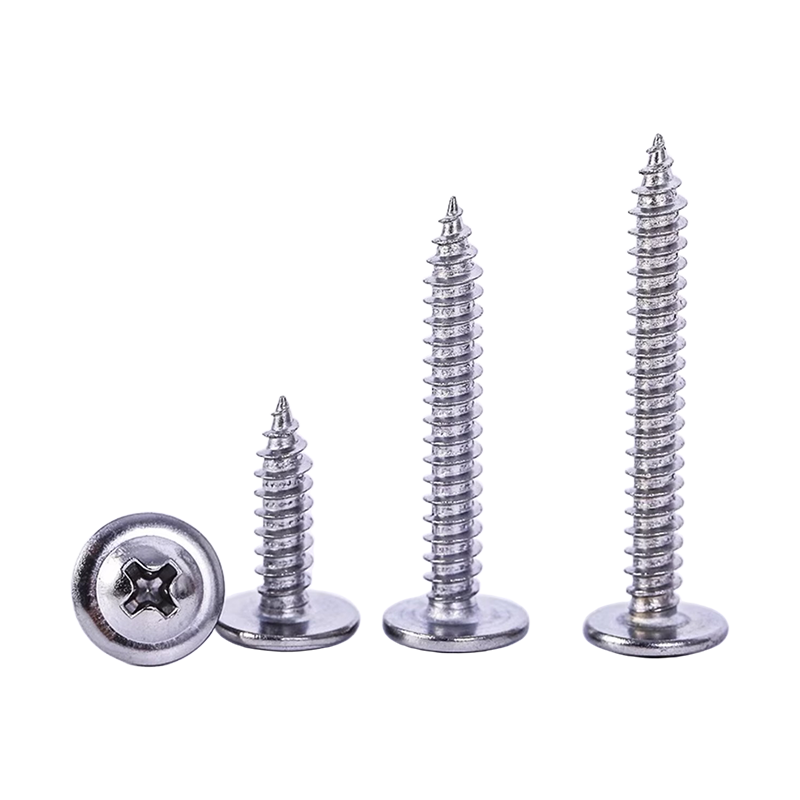
Galvanized Screws vs. Stainless Steel: Which Should You Choose?
The choice between galvanized and stainless steel screws is one of the most common fastener decisions in construction, decking, fencing, and outdoor joinery. Both resist corrosion, but through fundamentally different mechanisms — and that difference determines which is appropriate for a given application.
How Galvanized Screws Work
Galvanization applies a zinc coating to a steel core. Zinc protects steel through two mechanisms: it forms a physical barrier against moisture and oxygen, and it acts as a sacrificial anode — meaning that when the coating is scratched or damaged, the surrounding zinc corrodes preferentially, protecting the exposed steel beneath. This sacrificial action is unique to zinc-based coatings and does not exist in stainless steel.
Galvanized screws are produced by two main processes. Hot-dip galvanizing — immersing finished screws in molten zinc at approximately 450°C — creates a thick, metallurgically bonded coating of 45–85 microns. Hot-dip galvanized fasteners offer the longest service life of any zinc coating, typically 20–50 years in moderate outdoor exposure. Electroplated (electro-galvanized) screws carry a much thinner zinc deposit of 5–25 microns and are suitable only for sheltered or interior use — they are not appropriate for exterior applications despite being widely sold in general hardware stores.
Direct Comparison: Where Each Type Wins
| Factor | Hot-Dip Galvanized | 304 Stainless Steel | 316 Stainless Steel |
|---|---|---|---|
| Corrosion mechanism | Sacrificial zinc coating | Passive oxide layer | Passive oxide layer + Mo |
| Salt / marine exposure | Moderate (coating depletes) | Limited (pitting risk) | Excellent |
| Pressure-treated lumber (ACQ/CA) | Good (HDG only) | Marginal | Best |
| Tensile strength | High (steel core) | Moderate | Moderate |
| Cost (relative) | Low–moderate | Moderate | High |
| Appearance over time | Dull grey, may streak | Bright, may tea-stain | Bright, minimal staining |
| Food contact suitability | No | Yes | Yes |
The Pressure-Treated Timber Rule
Modern copper-based wood preservatives — ACQ (Alkaline Copper Quaternary), CA (Copper Azole), and similar formulations that replaced arsenic-based CCA treatments — are significantly more corrosive to fastener coatings than their predecessors. Many building codes in North America and Europe now require either hot-dip galvanized (HDG) or stainless steel fasteners in contact with preserved timber. Standard electroplated zinc screws and even some thinner galvanized coatings are explicitly disqualified. Verify the coating weight or grade specification on any fastener intended for ACQ or CA treated lumber — the label alone is insufficient confirmation.
When Galvanized Beats Stainless
Galvanized screws are not simply the budget alternative to stainless. In several specific applications, they are genuinely the superior choice. Heavy structural applications — lag screws, joist hanger fasteners, framing connectors — typically specify hot-dip galvanized hardware because the underlying carbon steel core provides higher tensile and shear strength than austenitic stainless steel at equivalent diameter. A 10mm HDG lag bolt handles higher shear loads than a 10mm 304 stainless equivalent. For structural wood connections where the fastener's mechanical contribution is calculated in the engineering, galvanized carbon steel often performs better while costing less.
Zinc vs. Stainless Steel Screws: Understanding the Real Tradeoffs
The comparison of zinc versus stainless steel screws is complicated by the fact that "zinc screws" is not a precise category — it can describe electroplated screws with a minimal zinc flash, yellow chromate-passivated zinc screws, hot-dip galvanized screws, or mechanically galvanized fasteners. Each carries significantly different performance. Comparing any of these to stainless steel without specifying the zinc process leads to misleading conclusions.
Zinc Coating Types and Their Actual Performance
Electroplated zinc (bright zinc or yellow zinc chromate): The most common and least expensive zinc treatment. Coating thickness of 5–12 microns provides corrosion protection measured in hours on the ASTM B117 salt spray test — typically 24–96 hours to white rust (zinc oxide) and 120–200 hours to red rust (iron corrosion). This translates to practical outdoor service life of one to three years in mild climates, less in coastal or industrial environments. These screws are appropriate for interior carpentry, furniture assembly, and sheltered applications only.
Mechanically galvanized zinc: A cold process that tumbles steel fasteners with zinc powder and glass beads, building up a coating of 25–75 microns without the heat distortion risks of hot-dip galvanizing. Salt spray performance reaches 500–1,000 hours. Suitable for moderate outdoor exposure but not for direct marine or pressure-treated timber contact without specification verification.
Hot-dip galvanized zinc (HDG): As discussed above, the high-performance end of zinc-coated fasteners. At 45–85 microns coating thickness and 1,000+ hours salt spray performance, HDG screws are appropriate for exposed outdoor structural use, fencing, decking, and pressure-treated timber in non-marine environments.
Where Zinc-Plated Screws Fail — and Stainless Does Not
The most consequential difference between standard zinc-plated screws and stainless steel is what happens when the protective layer is breached. A zinc coating, once depleted, leaves the carbon steel core fully exposed — at which point corrosion accelerates rapidly and the screw may fail structurally. The oxide layer on stainless steel, by contrast, is an intrinsic property of the alloy itself: if scratched, it reforms in the presence of oxygen within hours. There is no equivalent to "coating depletion" in stainless steel under normal conditions.
This distinction matters most in applications where fasteners are difficult or impossible to inspect and replace: buried ground contacts, submerged timber, concealed framing connections, and roofing fasteners under cladding. In these situations, the service life difference between a zinc-plated screw (2–5 years) and a 316 stainless screw (30–50+ years) justifies the cost premium many times over.
Where Zinc-Plated Screws Are the Right Choice
It would be a mistake to conclude that zinc-plated screws are always the inferior option. For interior applications — drywall, cabinet installation, interior trim, subfloor fastening, furniture assembly — the corrosion protection of stainless steel provides no practical benefit in a controlled, dry environment. Zinc-plated screws cost a fraction of stainless equivalents, are available in a far wider range of drive types and sizes, and are entirely appropriate for the application. Specifying stainless for interior drywall screws is unnecessary cost with no performance benefit.
The decision framework is straightforward: match the fastener specification to the corrosion exposure of the application, not to the most corrosion-resistant option available. Interior and dry = zinc plated. Exterior sheltered, moderate climate = mechanically galvanized or hot-dip galvanized. Exterior exposed, pressure-treated timber, coastal = hot-dip galvanized or 304/316 stainless. Marine, chemical, or food contact = 316 stainless.